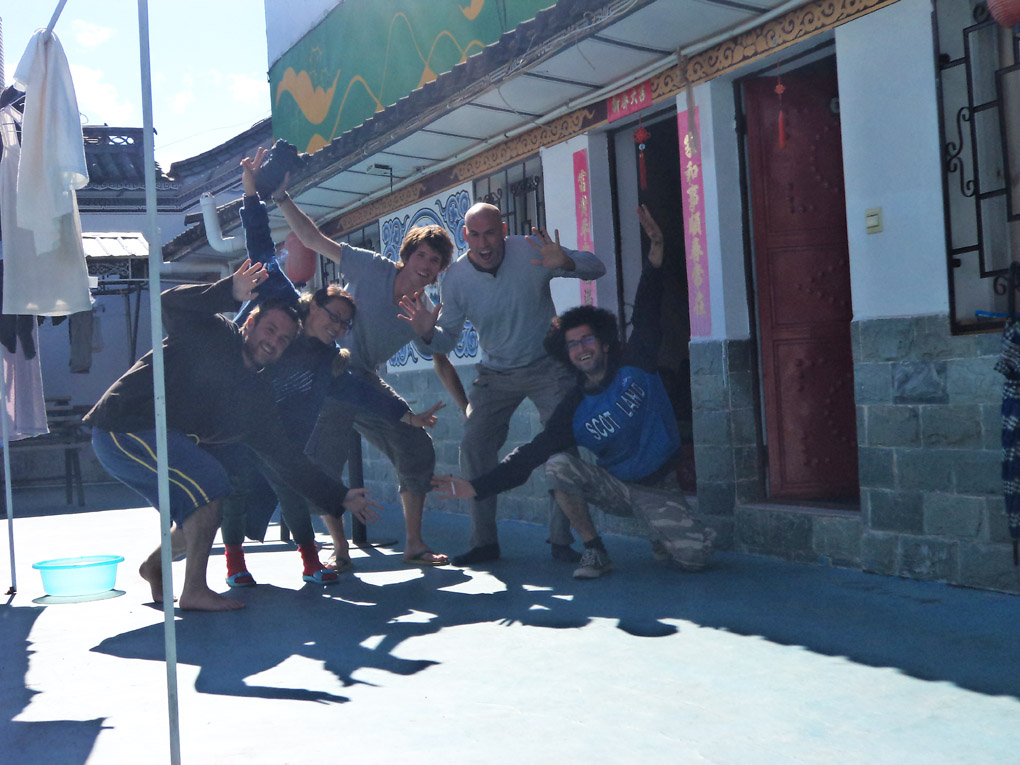
Tuesday, 17 January 2012

Videos

Now that I've got decent broadband here's some videos that I couldn't upload earlier, it seems pretty pointless when you can't see them then read about whatever it was I wrote to put them in context but never mind.


Dancing at the bank in Suzhou

Huangshan - Loving it, too cool.

To get an idea of what the atmosphere is like, put on a pair of headphones and put the volume at max.

A return to Chengdu park

Me and a yak herder, I sound like I have learning difficulties, my accent has changed and I speak so slowly.

My Crazy Encounters with the Deadly Wild Elephants of Southern China


Before I arrived in Jinghong, the last Chinese city before the Laos border, I had asked a restaurant owner if I could camp in their unused field. They fed me, treated me like a king and I was forced by old granny to stay for lunch the following day. The wee Granddaughter was amazed that my home country has swimming pools and gave me plenty of warning about the ferocious Daxiang (Elephants) that lay in my path ahead. They were a really nice family. The one armed grandfather told me how he had a motorcycle accident and refused to have medical treatment because he believed god would help him.  He has survived to tell the tale; I hope he survives to tell the tale of how his huge stomach abscess miraculously heals. Evangelical Christianity is growing in China at a phenomenal pace. I learned that the Chinese word for hallelujah and amen are the same as in English and that the word for god is Shendi. I had a really good time with this lively family who refused to take any of my money, they treated me so well it was almost embarrassing so leave having given them nothing in return.

I had earlier assumed I would have been entering Jinghong with plenty of cash to burn and was going to go to Karaoke for the first time in China (for the quintessential Chinese night out) and blow the rest of my renminbi on luxuries that I haven’t had in a while. 


I was hoping my bike would get trampled on by Wild elephants in the jungle near Jinghong after being told how dangerous they were. The photos of Elephants jumping on my bike and stealing my tangerines would have been epic. By mid-morning I was just hoping to see one, by midday I was hoping to hear an elephant and by the time I left wild elephant valley I was just content that the socks I’d washed in the stream had dried and my suntan had improved. No matter what I do or where I go, nothing out of the ordinary happens to me. Apologies if you thought the title of this blog entry was going to result in me ferociously fighting off stampeding tusks. I wasn’t being deceitful; this blog is about my encounters with wild elephants, which adds up to a grand total of none. However, I did see footprints on the mud of the riverbank which I washed my clothes in. The photos didn’t come out well but trust me, it was  Elephants that made them. Don’t tell me otherwise.


I arrived in Jinghong with little Chinese money left and after stocking up on camping gas, I spent my last day in a Chinese city trying to find the cheapest noodle stall instead. I was hoping something bad would happen as I left China so that I wouldn’t miss it if Laos turned out to be utter dross.

The last town I passed through before entering Laos was Mengla. I bought a jin (600g) of tangerines from a fruit stand and then was given loads of freebies (2 gorgeous fresh pineapples, 5 tangerines, 2 apples and a type of fruit that I’ve never seen before and was also given the opportunity to chat up the fruit seller’s highly attractive 26 year old daughter who lives in Kunming (I got nowhere). I will definitely remember China for its people doing everything they can to rip you off one minute and being unbelievably generous the next. Since I got my bicycle my Chinese has improved a lot and more often than not towards the end, I was overwhelmed with the friendliness, curiosity and generosity of its citizens. 

I arrived at the border the following day with enough cash to buy rice, a bowl of fried tomatoes and eggs, a small bottle of water and a can of coke. The radio was playing the same pop songs that were being played 5 months ago when I arrived in Beijing. I left China in the early afternoon and cycled the half kilometre or so to the Laos checkpoint. They allow you to pay in US dollars but wouldn’t accept my 100 dollar bill as they had no change. I wasn’t allowed back in China so spent about 3 hours waiting for a taxi driver to exchange money at a good rate. I had a pineapple, a Salman Rushdie book and plenty of cigarettes so it wasn’t too bad. I ended up paying 8% commission for exchanging my US dollars to Laos Kip. I suppose it could have been worse.

 I didn't know it that the time that this would be my last good meal for 300km
The border at Mohan


I reflected on my 5 months in the Middle Kingdom whilst lounging around in No Man’s land. China is too vast and varied to be summarised in a book let alone a short blog entry. I’ve shown a couple of people my route through China and they’ve been amazed at the amount of places I’ve seen whereas I look at my route and it feels as though I’ve whizzed by so many sections and missed so much even in the small percentage of the country that I was lucky enough to have the opportunity to travel through.

Looking back

When I hear the name China the first thought I think about is its beauty; its old pagodas, willow trees, bamboo swaying in the cool breeze, gravity defying mountains, lush fertile farmland with buffaloes ploughing the fields, round straw hats popping out of the rice fields as its farmers use every daylight hour to feed a billion mouths in techniques of an age old tradition. There is the smell of wood smoke and freshly cooked food in tightly clustered villages with chickens roaming the cobbled alleyways and children smiling and laughing as their grandparents look on from the comfort of their tiny little stools, gambling, smoking and watching the world go by. Inside are spacious houses with no consideration given to decoration but in a strange way, this functional clutter nevertheless has a definite aesthetic appeal. Chinese civilisation is the oldest living civilisation.

However, China isn’t always pretty, far from it. Many of its historical old walled towns that survived the wars in the first half of the 20th century were destroyed in the second half as Chinas communist government sought to modernise the nation with little or no consideration for its history or the livelihood of its people. As China has abandoned communism in favour of a market economy its wealth has boomed in the last 20 years Chinas and an emerging middle class has grown with an appetite to explore its nation’s roots. Much of the remaining old towns with their historic architecture still intact have become overly crowded holiday resorts that are more like theme parks than living cities; generic shop fronts sell items that nobody needs, every 2nd building is a guest house and the sound of crickets and the sight of the milky way at night has been replaced with the sound of countless bars pumping bad techno or very bad karaoke to the sight of neon lights and vomiting drunken youths. The local population is almost invisible and rarely treated with respect by its wealthy, city sleeking visitors who have found quick wealth and think overly highly of themselves as a consequence.

Most of Chinas big animals are either locally extinct or highly endangered as there habitat shrinks and they are killed for superstitious traditional ‘medicine’. This appetite for exotic ‘medicines’ is decimating the population of wild animals on a global scale and unless there are huge cultural changes within China, I can’t imagine this situation will get any better as the disposable income of Chinas growing middle class increases. Much of Chinas most beautiful terrain is getting ripped apart for mining, all but two of its hundreds if not thousands of rivers have been dammed (the Li and the Nujiang) and an astronomical amount of sand is being dredged from its rivers for construction materials. Lorry after Lorry belt out black fumes as they carry their cargo through beautiful but rapidly shrinking, picturesque landscapes to one of Chinas numerous indistinguishable, hazy, polluted cities.

The average Chinese city is by no means beautiful but they are full of life. The streets and lanes are a web of activity; you’re never far from the smell of food or the sound of car horns. In the evenings people don’t just lock their doors at night and shut themselves off from the world, they play cards, go dancing in the park or more often than not, just hang around and chat or watch the city as it moves. Neither the young nor the old, nor women feel threatened to go out at night, no matter how poor the street lighting is in the dark dingy lanes. Not once in 5 months did I see violence. When I lived above the town centre in Peterhead I didn’t even bother looking out my window if drunken people were fighting, it was commonplace. I once whacked my knee in someone’s ribs pretty hard when clambering up to my bunk on a sleeper train from Guiyang to Chongqing. I said ‘duibuqi’ and the middle aged man laughed even though he looked to be in pain. Showing anger in China just isn’t cool, they don’t glorify being tough and aggressive in Chinese society and I’m sure that the man wanted to punch me in the face but he just wouldn’t, it’s not the thing to do, I said sorry and he laughed, that’s how they roll.

You have to go a Chinese city to get an idea of the amount of construction that is taking place and even then, it’s impossible to fathom the scale of this growth on a national level. People have asked me why I wanted to spend so long in China of all places (when I could sit around beaches in Thailand instead)…. China is such a dynamic country, it’s energetic, and the changes that are occurring now will have reverberations around the globe for years to come. The greatest migration in human history is taking place in China. The Government project that 300 million people will be migrating from rural life to urban life within the next twenty years. I have a friend living in Shanghai who compares living in Shanghai now to living in New York at the turn of the last century. In my blog I earlier compared Chongqing to New York 100 years ago and you could justifiably compare Guangzhou, Shenzhen and Tianjin in that category too. Shanghai was just a village 100 years ago and is now a high tech, modern cosmopolitan city with a population of 24 million. Shenzhen was a mere village just 30 years ago and is now a city of 12 million and source of just about every product you see that has ‘made in china’ written on it.

These cities of new, towering, gleaming office blocks are a world away from so much of China. All of the wealthiest nations have a high rate of urbanism and I believe China faces two major hurdles in its quest to becoming a truly modern, high tech, post-industrial nation. The biggest hurdle to the government plans for mass urban migration is Chinas geography. Only 10% of the land is arable and that figure would be significantly lower if they didn’t farm steep mountain sides. The staple crop of rice requires a field to be totally flat so that it can be flooded at a controlled level. This means that so much of China is impossible to farm on an industrial scale. Unless there are huge leaps in technology in the coming years China will continue to be dependent on the work of peasants to feed the country and the average age of peasant farmers must be well into the 50’s. In Guizhou I saw countless people in their eighties who are half the height of what they used to be. These hunchbacks still work, providing essential farm labour carrying heavy loads. Almost all the young people migrate to the city as soon as they can. Whereas the youth create the vitality of its ever growing cities, it’s the pensioners that feed the cities and keep them running. The face of 21st century China is one of growth and upward mobility but the backbone of Chinas economy is old and frail. I had this discussion with a Swiss woman and she asked me if I was worried by this. I told her yes, but eventually the lack of farm labour would increase the cost of food which would provide economic incentives for younger people to farm. The man sitting next to me from Hong Kong was quick to agree. “China is the oldest continual civilisation and things will sort themselves out, like they always have done in the past”. Whereas I agree with him to an extent, Chinas long history hasn’t been without its fair share of disastrous episodes. The average working life left in these farmers who know the land intimately can’t be more than 30 years and you only need to look at Zimbabwe to see the consequences of large numbers of people with no background in agriculture being put in farms. I’m not saying things can’t be done swiftly and effectively and if any country can replace a workforce of 300million in the space of one generation then it’s China. They have lots to think about.

The second factor I believe may be a hindrance in Chinas aims to be a world economic leader is it’s education system or to get straight to the root of the problem – the government. Tianjin alone has a construction site with office space the size of lower Manhattan being built under the assumption that Chinese companies will be leading the global economy. How can a country lead the world economy when its people can’t be trusted to have information about how the world works? In order to lead one requires creative thinking to find solutions to problems. People in China are bred from birth to think with subservience and not think out the box. This hasn’t had much effect on Chinas economy while its growth is still primarily based on manufacturing but I believe China needs to allow more personal freedom if it is to move to the next level.

A lot of people fear China as it emerges into a global superpower, I can see why. It’s a dictatorship that’s becoming more powerful and polluting more and more as it gets wealthier and wealthier. It has made no secrets about its desire to make Taiwan part of China by force if necessary. The Chinese people generally regard all Chinese speaking places as being China as well as Tibet and Xinjiang even though the local populace may feel very differently. There continues to be simmering tension regarding the border disputes with its neighbouring nuclear powers India and Pakistan over the territorial boundaries of Kashmir and I even heard one Chinese person vehemently correcting me that Vietnam is a part of China that got stolen from them. The lack of education in how the world both in and outside of the middle kingdom works and the inaccessibility of objective information is worrying. Although many of the greatest atrocities of the modern age have been committed by democratic nations with a free press, the Chinese people, having lived in a one party state all of their lives are much more inclined to believe what they are told and act accordingly.

Having heard the scare stories about China taking over the world and now having spent a considerable length of time in China, I view the emergence of China from a sleeping giant to a major political player with less apprehension than much of my fellow westerners.  I’ve found the people to be kind and hospitable despite their cultural superiority complex (if you lived in the centre of the universe you’d feel the same)! They appear rude at times with their pushing in queues, spitting and very direct way of speaking. “Waiter, bring me water” is how they’d say “excuse me, can you please bring me some water”, but no harm is intended.

They are tough in business and will lie out their teeth to get a good deal and never give you a straight answer if you ask them a difficult question but that’s fair play as far as they are concerned, they are not dirty people . A taxi driver once tried to charge me 10 times the going rate, I corrected him, paid the correct fare then he chased me down the street to give me my bag I’d left in his car. A street vendor tried to overcharge me for rice when my bank card was locked and ended up giving me loads of free meat and veg when she realised I was genuinely skint. I was more often than not overwhelmed by the kindness of its people.

China is almost a whole nation comprising of only Children; I’ve talked in the past about the negative aspects of the one child policy but what would have happened if it hadn’t been put in place. The population is well over a billion and Chinese peasant wives were sprouting out six or seven, China would have had to either plunder other nations or starve. The pressure heaped on parents for their only child to be successful is huge. The education system is highly competitive as is the competition for jobs. Social status and the ability to find a partner is determined by wealth as it is in any other society but the pressure to succeed in China feels greater than what I’m used to.

Many of these from the one child generation are very well pampered by their parents and seemed to mature later than westerners as they don’t live very independent lives even after leaving school. Amongst many of the young people, I felt an overwhelming sense of pressure to succeed to the expectations of family, a sense of vulnerability and lack of confidence and more than anything a craving for a sense of belonging. I felt sorry for a lot of the lonely young men who couldn’t get a woman without a good job, one of the 25 million ‘spare males’ that’s occurred as a result of the one child policy. I didn’t see a generation of people to be feared in the future. The Chinese are like the French; their number one concern in life is food. They don’t want to take over the world, for the majority of them, all they seem to be really interested in is a plate of good ‘chifan’ and the latest mobile phone. 

I like Chinese culture and its people and as the nation moves forward at an astronomical pace, I fear the consequences of this explosion of activity as much for how it might affect its own citizens as for the consequences that this new world superpower might have for the citizens of the rest of the world, the environment and the welfare of the 200 or so wild elephants that leave footprints on riverbanks. I don’t care that I didn’t see them, I’m just happy to know that they are still there. I don’t know if I will always look at China with such fondness but I know I will always look at my own time in China as being one of the most educational and enjoyable times of my life. I have forgotten the names of every Chinese person I’ve met (apart from ones that give themselves English names) other than two. Jeng Peng in Beijing and this man here, Heng Hua Xin. As people get older their faces tell the story of their lives. I don't fear dying young or growing old. I fear living as long as Heng Hua Xing and having a face that tells the wrong story because unlike him, I failed to find a reason to smile at any given opportunity. Wo zoule, Zaijian.


Tuesday, 3 January 2012

The earth is my bed


·         A sleeping bag with a comfort level of + 15 degrees isn’t much use in December (even in Yunnan).

·         Chinese road signs rarely tell you how far it is to the next city but there are milestones every kilometre to tell you how far you are from the centre of the universe (Beijing).

·         Never say the Chinese word for yes (dui or shi), just nod your head and make an ‘uh’ sound. Never say that you understand someone (mingbai), just nod your head and go ‘uh’. Never ask someone if they understand you, (‘ni ting bu dong ma’), just tilt your head up and say ‘uh’. Whenever someone is talking to you, fill in every pause for breath with an ‘uh’ sound to show that you are listening. Saying ma at the end of a sentence turns a statement into a question, if you forget to add the ma at the end, just tilt your head up and go ‘uh’, they’ll know what you mean. Never say goodbye (zaijian), say ‘xiexie’ (thank you) to the shopkeeper then ‘wo zuole’ (I’m going) then look them in the eye, tilt your head up and go ‘uh’. Don’t expect a smile, a ‘have a nice day’ or a ‘thank you for shopping at Wal-Mart’, you might get a ‘xiexie’ or a ‘zaijian’ preceded by the ‘uh’ but more often than not they’ll grunt an ‘uh’ then continue watching their soap opera.

·      With blogspot you can check the nation of those who have viewed your page, the browser people have used to view your page and the google searches that have brought people to your page. The most common search that takes people to my blog is ‘taiyuan brothel’. I can’t imagine many Taiyuan brothels have an English website.

·         There isn’t much to do in a tent on your own – I go to sleep early, I’m packed and moving whilst the world is still sleeping.

·         Cycling up steep climbs at walking pace is a bit pointless when you can walk.

·         Having grammatically perfect Chinese helps when travelling through China but it is not essential. You start to pay local prices once you have perfected the correct usage of how and when to make the ‘uh’ sound. That’s when you know you’re starting to get to grips with the culture. Uh?

·         Tying a backpack to the back of a bike with bungee ropes and making it tight and evenly balanced on both sides is an art that I’m getting the hang of. I usually get it right first time now and in half the time it used to take.

·         Even though I’d been travelling for 5 months before I got my bike I feel that only now my journey has properly begun. I feel free. I’m a true nomad now (and a tramp).

·         Fortune rarely favours the reckless but the reckless have the best time of it while it lasts.

·         Pushing a bike up mountains with a bag full of clothes, shelter, cooking equipment, food, a laptop, toiletries and cycling maintenance essentials isn’t much easier than cycling up them.

·         Chinese people don’t care where you pitch your tent; so long as you’re not bothering anyone they are happy.

·         Horse and cart are the taxis and busses of some towns in Yunnan, notably around Weishan.

·         Seeing the early morning mist rising up bamboo clad, terraced mountains makes me feel extremely lucky, having a coffee and cigarette whilst watching this from the comfort of my sleeping bag makes me feel even luckier, especially if I don’t really have a clue where I am and I effectively just stumbled across this spectacle.

·         Chinese roads aren’t nearly as dangerous as people make out.

·         A pretty Chinese girl with high cheekbones, wearing big sunglasses, a bright red, hip length duffel coat, a short skirt with black tights and well-toned calf muscles sporting ridiculously long high heels whilst riding a scooter with her long hair blowing in the wind is the ultimate in sexiness. In fact, she may be the ultimate in everything.

·         I’m all up for the “Choose life” and all that, I just don’t expect the “cars, compact disk players, and big televisions” to make that much of a difference. Give me a tent, a bike, nice scenery, a culture of smiling, friendly people and I’m happy.

·         When it rains in Yunnan it really does rain.

·         Cycling with a bag that’s soaking wet is a bit of a **** and all the nice scenery in the world won’t make the slightest bit of difference.

·         Sleeping in rural hotels is always an option - 20kuai/£2/$3 a night before bargaining isn’t exactly a nightmare scenario.

·         I’ll maintain my belief that Chinese roads are relatively safe until I get run over.

·         Cycling all day makes me too tired to bargain even though I’m probably not paying the local rate. (it’s only 20 kuai a night).

·         Porridge with honey, jam, raisins and bananas is the perfect meal and takes less than 5 minutes to make.

·         I now regard any toilet with a roof as being luxurious no matter how dirty it is.

·         When a man who’s worked in a bike shop all his life laughs when you tell him you intend to take your cheap second hand set of wheels from Dali to Laos with a few scenic detours on the way and tells you it’s not going to happen, he may have a point (but he probably doesn't).

·         I’m healthier and happier than I’ve ever been.

·         Maybe ‘uh’ isn’t the best way to write it, maybe it should be ‘eugh’ or ‘ugh’. It’s like how a Brummy or Mancunian would say church, but with less effort involved. Think of someone from the Royle Family or Shameless having to do something that requires a bit of effort and to show that they can’t be bothered they make an ‘uh’ sound. That’s how you do it, now just make it that little bit snappier and less prolonged.

·         Washing clothes in irrigation channels is nearly as disgusting as bathing in the river Ganges – there are no dead bodies floating about but there’s everything else..

·         Times New Roman – I’m just not feeling it anymore.

·         I rarely swear (I rarely speak English coming to think of it) and don’t like it when I do swear,  it sounds really tacky but cycling in the rain with a bag that is soaking wet really is a bit of a ****. There is no nice way of putting it.

·         If I write a blog entry that is 40% good things and 60% moaning, it means I’m having the time of my life.

·         You think you’re cycling up those steep hills as fast as you can, then a big dog with a deep pitched growl starts barking and gnashing at your legs and you realise that you’ve got the energy to cycle faster, a lot faster.

·         A girl wearing high heels whilst driving a scooter can weave through the traffic so effortlessly that she might not even realise that there is a traffic jam, let alone realise that she caused it.

·         Finding somewhere suitable to pitch a tent with less than half an hour left of sunlight is a bit stressful – just about every bit of flat land in Yunnan seems to be used to grow something.

·         The sides of some Chinese roads are full of broken glass but their bottles are usually always green and usually always easy to see.

·         Just because someone can cause traffic jams doesn’t necessarily mean that they are not boring, now there is a bit of philosophy for you.

·         When a Chinese man tells you the road from point A to point B is flat, what he means is that point A and B are at the same altitude. He isn’t making any reference to the terrain in between.

·         Chinese women don’t grow old gracefully and maintain a great set of legs until a ripe old age.

·         You arrive in a town and ask someone how far it is until the next town that’s on your map. 80km. You cycle for about an hour and a half, stop for a drink of water and eat a biscuit and a local shopkeeper starts chatting and asks where your from, where your going etc. He tells you how far you’ve got to go. 80km. You keep on moving. It’s finally time for a cigarette break and a chance to give your thighs a rest. There is a woman waiting for a bus on the side of the road. You ask her….still 80km. You cycle for around another hour and a quarter then stop for a cigarette, the sun is blazing, the birds are in song, and your legs feel slightly wobbly from all that pedalling. There is a man walking towards you with a bamboo cane on his back and two big sacks of Fresh farm produce tied to either end. He’s heading to the market that you’ve just bought some tangerines from. You say hello and ask him how far it is to the town. He says 36km. Finally someone who knows the local geography. To double check you ask him how far it is until the town you’ve just came from. He tells you it is 80km. He asks you where you’re from. You tell him you are from Scotland. He looks at you blankly. You say you’re from Yingguo (the United Kingdom). His face lights up and he repeats what you’ve just said. You nod your head and say ‘uh’, answer a few questions then pedal on. To your surprise, it’s just a short distance then you arrive at your destination. You see a group of young men in their late teens looking at the foreigner on a bike with excitement and curiosity. They’ve been learning English throughout their school years. They say hello in English then speak to you in Chinese. You answer a few questions. They ask you a question that you don’t understand and you reply ‘ting bu dong’. They repeat the question and you give them the same response. Their enthusiasm to communicate suddenly diminishes. To satisfy your own curiosity you ask them how far it is from where you are to the town you just came from. They tell you how far it is then they all say goodbye in English with great pride and enthusiasm. One of them shouts Welcome to China as you leave even though you’ve just told him that you’ve been in China for 4 months. The answer to your question that you asked them….80km.

·         Do not smoke anything that grows on the side of the road. It will make you do daft things such as buy a packet of cigarettes, spend 5 minutes making sure your change is correct because you keep on losing count. You leave the shop, take out your lighter then realise that you’ve left your cigarettes on the counter and beside the stool that you sat on whilst counting your money is your change, your half eaten bag of biscuits and your bottle of water. You were too busy peeling a tangerine to notice.

·         If you camp in rural china, it’s a wise idea to memorise the location of all the buffalo pooh in case you need to urinate in the night.

·         Forget finding an English speaker, its difficult enough finding someone who can speak Putonghua in some rural parts of Yunnan. It feels strange to meet Chinese people who speak even less Chinese than me.

·         Chinese counties tend to be named after their biggest town. So when you ask how many kilometres it is until Weishan, they tell you that you’re in Weishan.

·         Yuanyang Rice Terraces – go there if you get the chance, I’ll say no more.

·         I don’t know how so many people can fail to see the beauty amongst life’s brutality – it’s everywhere.

·         When a man tells you that the Chinese like to smoke after meals because that’s what they do in heaven, just agree, especially if he’s paid for the meal that you’ve just eaten. Just nod, make an ‘uh’ sound, smoke your cigarette that he’s given you and agree.

·         When you go into a Chinese shop you don’t have to put up with Jingle Bells or that Pogues song about New York for two months solid in the build up to Christmas. Fantastic.

·         Don’t assume a Chinese woman is young and pretty if she looks good from behind. Don’t assume anything. In fact, just don’t look. 9 times out of 10 she will be young and pretty but the trauma from that 1 time out of 10, oh the trauma. Just don’t look. Forget I even mentioned it. She could be old enough to be your granny and not the sort of pretty granny that you see whilst staggering home from the pub at 2am on a Wednesday night either.

·         Yunnan has a handful of locations where tourists flock to but away from there, many people have never seen a foreigner. There you can behave however you like. The locals will assume your culture is strange rather than realise that you’re just an idiot.

·         If you camp in rural china, it’s a wise idea to wear shoes if you go for a piss in the night.

·         Happiness is a bowl of porridge.

·         Waterproof clothing makes you dripping wet with sweat but I still put them on whenever it rains. I think about how pointless it is whilst I’m putting them on but even then, I still put them on and 5 minutes later I’m soaking and I’m wondering why I bothered putting them on. Then the sun comes out and it takes me 10 minutes to take them off, pack them in my bag, fasten everything up and get going again. By that time I would have been dried by the sun anyway but I still put them on. Whenever it rains.

·         I was somewhere in between Honghe and Yuanjiang. The heat was blistering and I was running out of water. It was about 10km since I last passed a shop and I didn’t know when I’d pass another one. The water from the Red river below was too murky to drink even after boiling it. I was desperately hungry but also gagging for a coffee. I did not have enough water for both. A dilemma of this magnitude needs a calm but decisive response. What should I do?

·         The ultimate happiness is a bowl of porridge with honey, raisins, bananas and jam in it.

·         China feels even vaster when you need to use muscle to get through it. My thighs feel like they are burning on a regular basis.

·         Intense contentedness can be a form of insanity - sometimes I have to remind myself that there is brutality amongst life’s beauty.

·         I hate visa restrictions.

·         My current lifestyle is not an easy one, far from it, but it’s phenomenal.

·         I know I’ve criticised China quite a lot in my blog but Chinese people are so friendly and cheerful towards foreigners, it’s unbelievable. I rarely lock my bike, it seems so pointless.  When I do, I feel embarrassed if a local sees me taking these precautionary measures, it almost feels as if I’m insulting their community when I pull my bike up at the side of the road and tie the lock. This nation is not perfect but it is about as safe a country as you’ll find. My favourite time of day is when the kids are walking home from school. All I get from them is a hello but their enthusiasm is infectious.

·         Pepsi Max is basically just Pepsi with caffeine in it. I name the response to my emergency dilemma Porridge Max. It was absolutely disgusting and will never catch on but at least I can claim to have invented something.

·         The dogs get close, they make the hairs stand on end but they’ve never sunk their teeth in.

·         It’s been sunny almost every day in Yunnan in December.

·         Every day, something happens that makes me think, wow, life is amazing, beyond comprehension.

·         I have neither watch nor mobile phone. With the way I live my life, there is day time, night time and times when I’m hungry, in which case I make myself a bowl of porridge.

·         I pretty much do whatever I want, spending very little and polluting very little in the process.

·         The earth is my bed and my blanket is the stars.


Dali

The good all year round climate supports wild plants that draw in tourists, particularly the laid back dread locked types. The old city is only double the size of my former home town, Peterhead, so it's easy to pass someone in a coffee shop who you met in a bar a few nights before, spend an hour chatting to them, get lunch, bump into someone else and another hour has gone by.  I've met loads of interesting and fun people to be around from many different nationalities.  It is so easy to wile away weeks or even months in Dali and not know where the time has gone, many people passing through choose never to leave. Apparently Dali used to be even more liberal, people would openly smoke herb on the streets and bars until Newsweek published an article highlighting Dali as the weed capital of China and the authorities clamped down. A shower can take an hour because you forget whether you've washed yourself or not, so do it again. I have no watch and my mobile broke months ago, so time is not a concept that means much to me. I don't feel my time in Dali was wasted even though I did nothing, you learn a lot from talking, listening and playing chess. 

I was excited to leave Dali even though I really liked it there, met loads of nice people and made some good friends. I don’t think I’d want to live there but I can understand why so many people never leave. One guy in the hostel had been living there for a month. He’d only leave the hostel to pick a bag of weed from one of the nearby fields then he’d lie in bed all day, only leaving his room to smoke a spliff, play chess and have the occasional game of ping pong. He’s a really nice guy and seems reasonably happy but that’s not the life for me, after a fortnight or so it would get a bit tedious. But if that is what you’re into then Dali is the place to do it. You can get a month’s rent for about £80, the weed is free; you get your room and toilet cleaned for you, shower gel, hand wash and toilet paper gets stocked up for you, the wi-fi is free, fast and bypasses the great firewall, there is a pool table, ping pong table and big widescreen television and cheap but good food can be cooked for you and delivered to your room. The cost of a cleaner alone would be about the same price in the West.

I was given a lesson on bicycle maintenance by Jane who works in the Jade Emu Guesthouse (best hostel in China) and an extensive lesson from a man named Jack who has cycled from Russia to Dali. He also gave me a spanner and a puncture repair kit and some clips to tie things and I got given climbing ropes by a guy in my dorm. I had a full set of clean clothes that had been washed in a washing machine. The Jade Emu is the only hostel I’ve been to that has a free machine; I’d been hand washing since Beijing, 4 months. With salvation by the cranberries ringing through my head I set off. I had to return after losing yet another pair of glasses, I bought spare tyres in Xiaguan and it came to 56 kuai. I gave him 60 and told him to keep the change. I then enquired about other things that Jack had told me I needed to get and was given a screwdriver, Allen key and a few adjustments to my bike from the shop free of charge. I was also told there was no way my 400 kuai bicycle would get me to Laos but they wished me the best of luck anyway (at least I think that’s what they were saying). I had been to Xiaguan once to buy a bike, 3 times to try and sort out an on-going financial thing and was glad to leave the city for the 5th and final time.


Lijiang

This city only has one Drawback - it's beauty. Lijiang would have been the best places in the world to visit about 10 years ago but it's beauty has resulted in the economic benefits as well as the death of traditional culture that mass tourism on a Chinese scale brings. Canals flow through it's winding lanes, there are weeping willows all over the place, beautiful ornate housing and an awesome mountainous backdrop. The local Naxi people are the only people left in the world who still use a hieroglyphic alphabet. They are traditionally a matriarchal society, not keeping track of their paternal linage. The women gained social status by having multiple sexual partners and although this aspect of their culture is not widespread any more (Mao's cultural revolution put an nd to all of that), many a single desperate Chinese man can be seen walking it's streets looking for love. Tourism has killed the traditional culture within Lijiang itself but the surrounding towns and villages haven't changed much or so I've been told. I was more interested in heading to Dali than spending more time here. I don't even know why I'm mentioning Lijiang. I arrived, had a wander and left. I quite like it in fact. The traditional local culture isn't completely dead, not for now.

 A man and a pipe
Card players
The most iconic view in Yunnan, I would have refused to pay the entrance fee but the guards were lazy, so I just walked through. In the background is the Jade Dragon Snow Mountain which is supposed to have snow on it.
Naxi hieroglyphics


Sunday, 4 December 2011

Nomad Culture and well fed Vultures

Myself and Martijn (the Dutch fellow) had a wander around the town, and climbed a mountain at the back of the towns huge monastery. Litang is one of the highest towns in the world at 4100m and many rests were needed due to the lack of oxygen. Martijn got altitude sickness so I climbed the last 100 metres or so, on my own. I was well chuffed to have got to the top. Flying around the mountains were huge Crows and Vultures which have a good balanced diet of humans and more humans. The people in this area believe that once the body dies it is worthless and they don’t get all sentimental about their relatives corpses. The bodies get taken to the top of the mountain and a monk opens out the ribs to let the birds eat out the organs and once that is all devoured the bones get cracked to allow them to eat the marrow. Unfortunately no-one was having a funeral when I was there; it would have been fascinating to see. I like this tradition. We take so much out of the food chain during our lives; it’s good to give something back when you’re dead. Getting buried or cremated is such a waste of protein. When I die, I want to get made into pig feed and have a nice wee picture on the bag, a bit like the KFC logo but with me on it and pig feed written in bold capitals.

Two little piggies


In the evening Longlife took Mimi the Japanese girl and myself to one of Litang’s two nightclubs. Everyone stands in a big circle moving in a style very similar to line dancing to Traditional Tibetan music with techno drum beats and the occasional Indian song. The T.V plays Bollywood films in the background as do many Tibetan restaurants, The Tibetan people seem to affiliate themselves more with Indian culture than Chinese culture. Myself and Mimi got invited into a private booth where we got free drinks and I served as a translator for all the single men who wanted to tell Mimi how pretty she was. They don’t waste time in talking about marriage. Some of them were carrying big swords that were razor sharp. Longlife says it is normal for young men to protect themselves in this way. Needless to say, I wasn’t brave enough to try chatting up the locals even though the girls that weren’t wearing face masks were very attractive. I got involved in the dancing instead and managed to learn some of the easier repertoires. With the air being so thin and the light pollution being more or less non existant, the stars were unbelievably bright on the walk home. Were it not -11 degrees I would have watched them longer. 

Paranoid about the threat of snow I went with Mimi and Martijn the following day to Daocheng. That’s only 1 days travel from the Tibetan Plateau to warmer climates so the chances of getting stuck in ice and snow for months at a time was drastically reduced. Whole towns and cities in the plateau are pretty much isolated for months. Daocheng is thoroughly not very special. Were it not for the evening games of poker using sesame seeds as chips I would have been pretty bored.

There are supposed to be daily busses from Daocheng to Shangri-La in Yunnan province but a Japanese fellow named Shuzi had been waiting for two days and we were told at the bus station that we’d have to return daily to the bus station to check if a bus was coming and we’d have to wait a minimum of two days. Along with a Swiss girl and two Chinese we hired a 7-seater mini bus. It was a 10 hour very bumpy journey across unpaved mountain roads. I had diarrhoea 3 times before the minibus left and contemplated waiting a few days for the bus but thought about Aarons epic touching the void quote. I went to the toilet 9 times in total that day. I’m glad I went because I later met an English girl who was supposed to meet her friend in Shangri-La but she was stuck in the Tibetan Plateau due to snow and ice on the roads. If we had been in Daocheng one day more we’d have been stuck as well. Not many people can claim to have squatted on the side of a 4000m mountain pass in late November; I’ll be putting that on my C.V too.  

Although Shangri-La is not exactly tropical, it is much warmer than where I have come from. It has felt strange being in Shangri-La, I’m used to being alone not in a big group. It’s good to have company and sharing 5 dishes between 7 is a lot more interesting than eating alone. I got given a proxy by Martijn so I’ve bypassed Chinas stringent internet laws and updated my blog and I’ve been reading my Khaled Hosseini novel and have decided that Afghanistan has replaced Nepal or Iran as the country I most want to visit in Asia. I’ve been researching on visas, places to go and which are the safest border crossing. Maybe that should be reworded to least dangerous border crossings? I don’t think I’m a reckless person and if I get to Pakistan and conclude it isn’t safe I’ll go just go through Southern Pakistan to Iran. Maybe I’m naïve but I think the most dangerous place would be getting from the mountainous areas on the Pakistan border into Afghanistan. So long as I stay away from Helmand and Kandahar, Afghanistan should be relatively safe, certainly in comparison to the tribal zones in Pakistan. I’ll learn some Pashto before I go and grow a decent beard.

The old town of Shangri-La isn’t very appealing to me. It has 3 names, a Chinese one (Zhongdian), a Tibetan one (Diqing) and one that they created to attract tourists. They claimed Zhongdian was the paradise named Shangri-La in some book that inspired a hotel chain. I can imagine that Shangri-La is nearly as bad as Fenghuang during warmer times of year but it is relatively quiet in Late November. The locals far outnumber the tourists, not that I’m justified in complaining when there are lots of tourists. By the sounds of it, Lijiang, my next port of call is far worse than Fenghuang regarding crowds of inconsiderate tourists.

The locals dance every night in the square to the same line dancing moves that were in the nightclub in Litang. It was really nice seeing a young man with very fashionable modern clothes doing the same moves as the woman next to him who was old enough to be his granny. You just don’t get that kind of cultural connection between young and old in the western world. 


On my last night in Shangri-La/Zhongdian/Diqing they played the DVD of Into the Wild. It’s a fascinating story of a young American who donated all his money to charity living a nomadic lifestyle on peanuts before going to Alaska where he died of starvation and from eating poisonous species of plants. I felt a bit embarrassed about what I had named my blog. He had called himself Supertramp and I could see a lot of similarities between the lifestyle he chose to live and the lifestyle I aspired to live and having reflected on my 4 and a half months on the road feel a bit embarrassed about how easy I’ve made it for myself. I acknowledge that sciatica played a part but it’s no longer relevant and I haven’t made many changes to my lifestyle since I’ve been unaffected by it. I’m looking forward to getting a bike in Dali and living a less planned; less predictable and less wasteful life. Even though I’ pretty good with the language considering I’ve only been in China for 3 months and have got more off the beaten track than most people I've met, I feel like I’ve wasted a lot of time and opportunities. I’m off to Lijiang then Dali. My time In Tibetan culture has been fascinating but brief. I’d love to return in warmer times but I’m glad to be heading south to lower altitudes. I am looking forward to some change.